In children ages 4 to less than 18 years old with acquired HO
IMCIVREE has been shown to deliver significant, clinically meaningful, and sustained results


Actor portrayals
How was IMCIVREE studied?
IMCIVREE was studied over the course of 1 year in a clinical study that included 142 children and adults aged 4 years and older with acquired HO. People were randomly assigned to receive IMCIVREE (94 people) or a placebo (48 people), meaning they were not treated with IMCIVREE. Body mass index (BMI), a measure of body fat based on height and weight, was used to evaluate changes over time.
What was the impact of IMCIVREE?
In children and adults 4 years of age and older with acquired HO, IMCIVREE delivered significant, rapid, and sustained weight loss
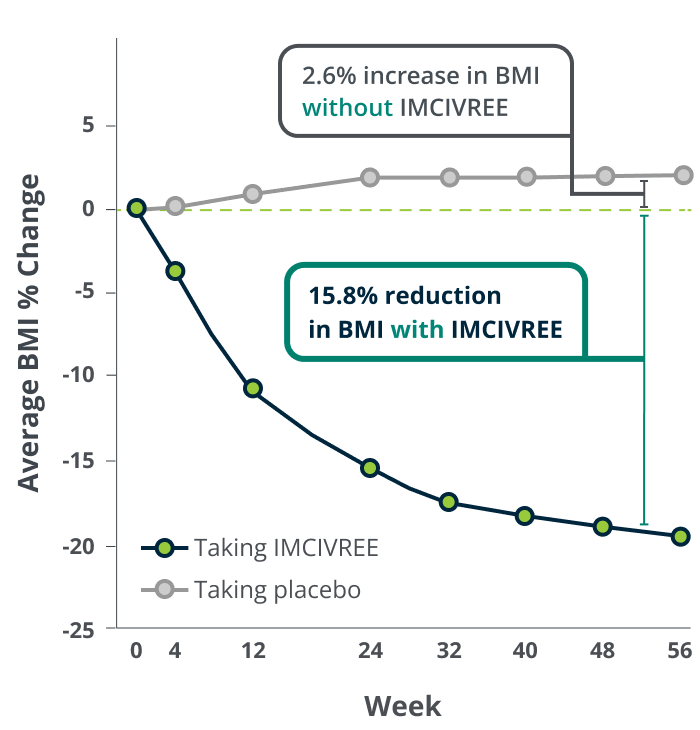
After 1 year, children and adults 4 years and older taking IMCIVREE saw a reduction in BMI, while those taking placebo (not taking IMCIVREE) saw an increase.
BMI change over 1 year
18.4%
average BMI reduction compared with those taking placebo after 1 year
Results were consistent across age groups.
Rapid and sustained BMI reduction with IMCIVREE
- By Week 4, some people began to see reductions in their BMI
- Most people who took IMCIVREE continued to lose weight throughout the year-long clinical study
How did IMCIVREE impact BMI in children with acquired HO?
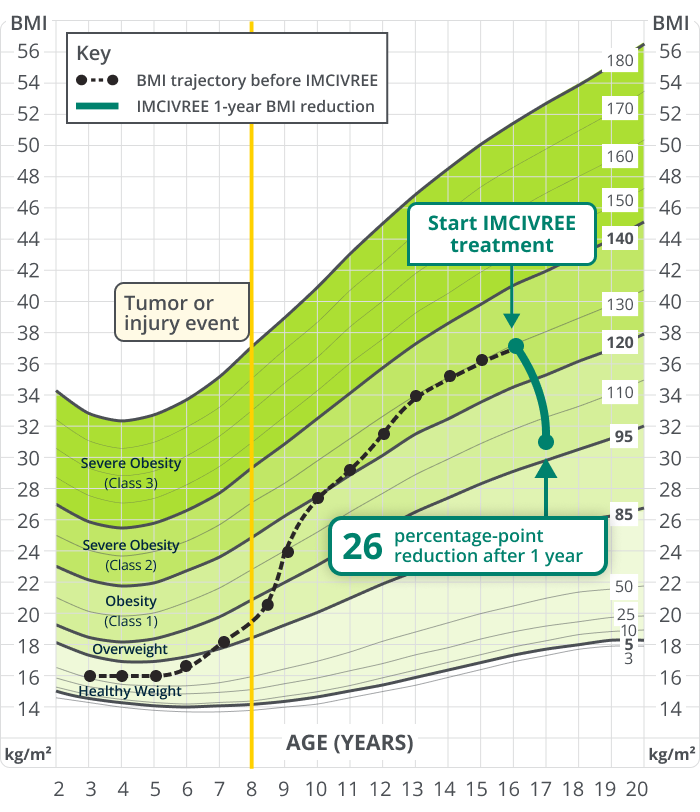
In children ages 4 to less than 18, IMCIVREE improved weight trajectory
You may be familiar with growth charts used to track a child’s height and weight compared with other children the same age. The growth chart here is a representation of a girl with acquired HO. It shows how IMCIVREE might help to lower her BMI, based on results from the IMCIVREE clinical study.
Representative growth chart for a child with acquired HO before and after IMCIVREE
70%
of children* achieved a healthier weight class after 1 year
Not an actual patient. Growth chart based on females 2 to 20 years of age and for illustrative purposes only.
*32 out of 46 children in the study. Three children were not included in the analysis.
How did IMCIVREE impact hunger?
IMCIVREE significantly reduced hunger in people 12 years and older taking IMCIVREE compared with people taking placebo (not taking IMCIVREE).
Greater hunger reduction with IMCIVREE
After 1 year, people 12 years and older taking IMCIVREE reported a larger average drop in hunger scores compared with people taking placebo.†
How hunger was measured in the study: People 12 years and older in the study completed a daily hunger questionnaire from the start of the study through 1 year. They rated their hunger on a scale from 0 to 10, with 10 being the hungriest possible and 0 meaning not hungry at all.
Reported impact on symptoms of hyperphagia
People 12 years and older who took IMCIVREE and were able to self-report were asked questions from the Symptoms of Hyperphagia questionnaire. Based on their responses, scores measuring symptoms of hyperphagia decreased after 1 year.
This study was not designed to draw conclusions for this measurement, and these results should be interpreted with caution.
†Scores dropped 2.3 points with IMCIVREE compared to 1.4 points without IMCIVREE, a difference of 0.8 points.

Actor Portrayals
Because she’s not constantly stressing over food and when her next meal will be and what she can eat and how much she can eat, she’s not in distress constantly.
- Caregiver of a patient on IMCIVREE
Individual results may vary.
How did IMCIVREE impact other health measures?
Children and adults 4 years and older taking IMCIVREE showed positive changes in:
Weight loss with IMCIVREE was also associated with a reduced waistline.
On average, children and adults taking IMCIVREE lost more inches from their waistlines compared with people taking placebo (not taking IMCIVREE). Waist circumference can be used as a measure of excess fat.
This study was not designed to draw conclusions for these measurements.
How did IMCIVREE impact weight-related quality of life?
As part of this study, people with acquired HO were asked to evaluate aspects of their weight-related quality of life.
For children, weight-related quality of life was measured using the Impact of Weight on Quality of Life (IWQOL)-Kids.‡ This survey asked questions related to the following areas:
- Physical comfort
- Body esteem
- Social life
- Family relations
Children ages 11 to less than 18 taking IMCIVREE saw a 12-point increase in scores on average after 1 year compared to a 1-point decrease in scores in children taking placebo (not taking IMCIVREE).
This study was not designed to draw conclusions for this measurement, and these results should be interpreted with caution. An increase of at least 4.8 points in the IWQOL-Kids test has been considered clinically meaningful for children with general obesity.
‡The IWQOL-Kids is a validated 27-item self-report measure of weight-related quality of life for children and adolescents. The questionnaire was used for assessing weight-related physical and psychosocial functioning in weight management clinical studies. Scores range from 0 to 100, with higher scores reflecting higher quality of life.
Talk to your child’s doctor about IMCIVREE today.
Prepare for your child’s doctor’s appointments with a discussion guide that can help you start the conversation about acquired HO and treatment with IMCIVREE.
Get personalized one-on-one support from a Patient Education Manager (PEM).§
Learn about the possible side effects of IMCIVREE.
§Patient Education Managers are employees of Rhythm Pharmaceuticals and do not provide medical care or advice. We encourage you to always speak to your healthcare providers regarding your medical care.