aHO Medication Efficacy in Adults | IMCIVREE® (setmelanotide)

In adults ages 18 and older with acquired HO

IMCIVREE has been shown to deliver significant, clinically meaningful, and sustained results

Three adolescents sitting around an outdoor table

Actor portrayals

How was IMCIVREE studied?

IMCIVREE was studied over the course of 1 year in a clinical study that included 142 children and adults aged 4 years and older with acquired HO. People were randomly assigned to receive IMCIVREE (94 people) or a placebo (48 people), meaning they were not treated with IMCIVREE. Body mass index (BMI), a measure of body fat based on height and weight, was used to evaluate changes over time.

What was the impact of IMCIVREE?

In children and adults 4 years of age and older with acquired HO, IMCIVREE delivered significant, rapid, and sustained weight loss

After 1 year, children and adults 4 years and older taking IMCIVREE saw a reduction in BMI, while those not taking IMCIVREE saw an increase.

BMI change over 1 year
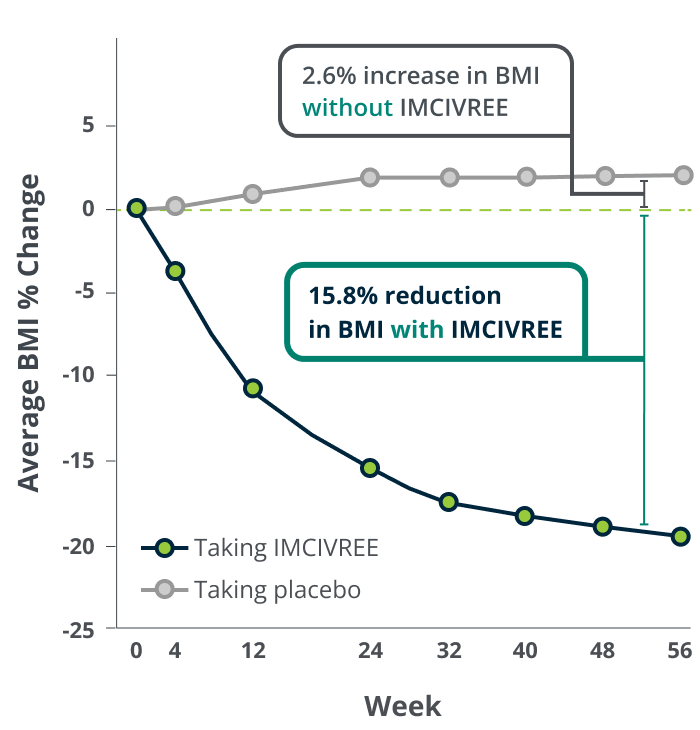
BMI change over 1 year on IMCIVREE® (setmelanotide)

18.4%

average BMI reduction compared with those not taking IMCIVREE after 1 year

Results were consistent across age groups.

Rapid and sustained BMI reduction with IMCIVREE

  • By Week 4, some people began to see reductions in their BMI
  • Most people who took IMCIVREE continued to lose weight throughout the year-long clinical study

How did IMCIVREE impact BMI in adults with acquired HO?

IMCIVREE helped people 18 years and older achieve a healthier weight class

The BMI chart here shows a representation of an adult female with acquired HO and how IMCIVREE might help to lower her BMI, based on results from the clinical study.

Representative BMI chart for an adult with acquired HO before and after IMCIVREE
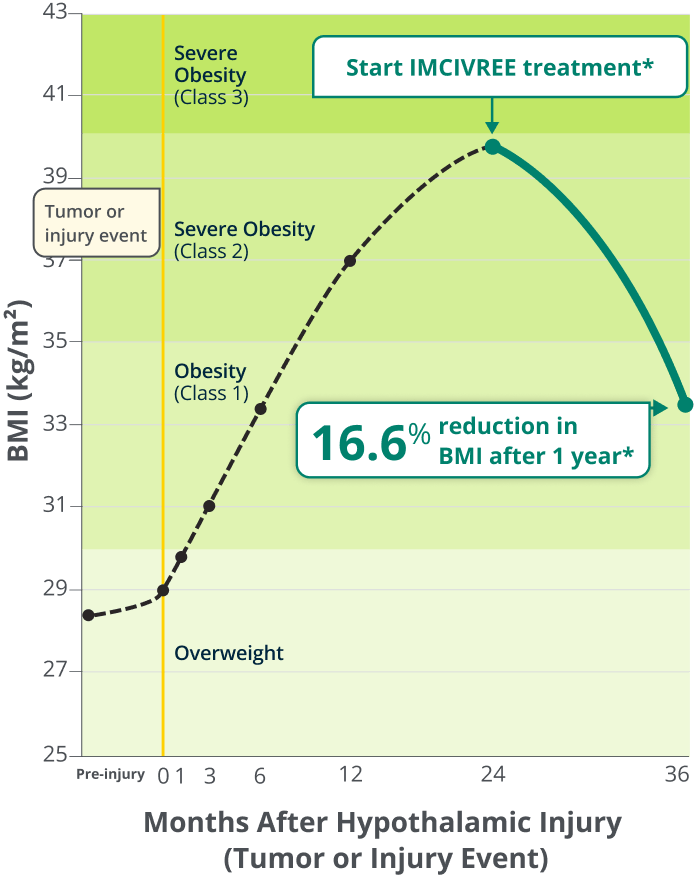
Representative BMI chart for an adult with acquired HO before and after IMCIVREE

71%

of adults achieved a healthier weight class after 1 year

Not an actual patient. BMI chart is for illustrative purposes only.

*BMI at the start of IMCIVREE treatment and after 1 year with IMCIVREE are average values for adults 18 years and older in the Phase 3 trial.

27 out of 38 adults in the study. Seven people were not included in the analysis.

How did IMCIVREE impact hunger?

IMCIVREE significantly reduced hunger in people 12 years and older taking IMCIVREE compared with people not taking IMCIVREE.

Plate with spoon, knife, clockwise circular arrow icon - Hunger reduction

Greater hunger reduction with IMCIVREE

After 1 year, people 12 years and older taking IMCIVREE reported a larger average drop in hunger scores compared with people not taking IMCIVREE.

How hunger was measured in the study: People 12 years and older in the study completed a daily hunger questionnaire from the start of the study through 1 year. They rated their hunger on a scale from 0 to 10, with 10 being the hungriest possible and 0 meaning not hungry at all.

Reported impact on symptoms of hyperphagia

People 12 years and older who took IMCIVREE and were able to self-report were asked questions from the Symptoms of Hyperphagia questionnaire. Based on their responses, scores measuring symptoms of hyperphagia decreased after 1 year.

This study was not designed to draw conclusions for this measurement, and these results should be interpreted with caution.

Scores dropped 2.3 points with IMCIVREE compared to 1.4 points without IMCIVREE, a difference of 0.8 points.

Woman and man at outdoor table

Actor Portrayals

I feel like I’m more in control. I feel like I’m making decisions, not just hunger that takes over. I feel like I can have meals and move on and not have it consume me.

– IMCIVREE patient

Individual results may vary.

How did IMCIVREE impact other health measures?

Children and adults 4 years and older taking IMCIVREE showed positive changes in:

Heart with gauge icon - Blood pressure

Blood Pressure

Droplet with colored circles and test tube icon - Cholesterol

Cholesterol

Test tube with magnifying glass icon - Blood sugar (A1C)

Blood Sugar (A1C)

Weight loss with IMCIVREE was also associated with a reduced waistline.

On average, children and adults taking IMCIVREE lost more inches from their waistlines compared with people who did not take IMCIVREE. Waist circumference can be used as a measure of excess fat.

This study was not designed to draw conclusions for these measurements.

How did IMCIVREE impact weight-related quality of life?

As part of this study, people with acquired HO were asked to evaluate aspects of their weight-related quality of life.

For adults, weight-related quality of life was measured using the Impact of Weight on Quality of Life-Lite Clinical Trials (IWQOL-Lite-CT) version.§ This survey asked questions related to the following areas:

  • Physical
  • Physical function
  • Psychosocial

Adults 18 and older taking IMCIVREE saw a 30-point increase in scores on average after 1 year compared to a 4-point increase in scores in adults who did not take IMCIVREE.

This study was not designed to draw conclusions for this measurement, and these results should be interpreted with caution. An increase of at least 16.6 points in the IWQOL-Lite-CT test has been considered clinically meaningful for adults with general obesity.

§The IWQOL-Lite-CT is a validated 20-item self-report measure of obesity-specific quality of life questionnaire for adults. The questionnaire was used for assessing weight-related physical and psychosocial functioning in weight management clinical studies. Scores range from 0 to 100, with higher scores reflecting higher quality of life.

Contact information icon

Talk to your doctor about IMCIVREE today.

Prepare for your doctor’s appointments with a discussion guide that can help you start the conversation about acquired HO and treatment with IMCIVREE.

Get personalized one-on-one support from a Patient Education Manager (PEM).

Learn about the possible side effects of IMCIVREE.

Patient Education Managers are employees of Rhythm Pharmaceuticals and do not provide medical care or advice. We encourage you to always speak to your healthcare providers regarding your medical care.

What is IMCIVREE?

IMCIVREE is a prescription medicine used in adults and children 4 years of age and older with acquired hypothalamic obesity (HO) to help them lose weight and keep the weight off.

IMCIVREE is not for use in people with the following conditions because it may not work:

  • Other types of obesity not related to acquired HO or other FDA-approved uses of IMCIVREE, including obesity associated with other genetic conditions and general obesity

It is not known if IMCIVREE is safe and effective in children under 4 years of age with acquired HO.

Important Safety Information

Do not use IMCIVREE if you have had a serious allergic reaction to it or any of its ingredients. Serious allergic reactions, including anaphylaxis, can happen.

Before you use IMCIVREE, tell your healthcare provider about all your medical conditions, including if you:

  • Have or have had areas of darkened skin, including skin discoloration (hyperpigmentation)
  • Have or have had depression, or suicidal thoughts or behavior
  • Have kidney problems
  • Are pregnant or planning to become pregnant. Losing weight while pregnant may harm your unborn baby. Your healthcare provider may stop your treatment with IMCIVREE if you become pregnant. Tell your healthcare provider if you become pregnant or think you might be pregnant during treatment with IMCIVREE
  • Are breastfeeding or plan to breastfeed. It is not known if IMCIVREE passes into your breast milk. You should not breastfeed during treatment with IMCIVREE

Tell your healthcare provider about all the medicines you take, including prescription and over-the-counter medicines, vitamins, and herbal supplements.

See the detailed Instructions for Use that come with your IMCIVREE to learn how to prepare and inject IMCIVREE, and how to properly throw away (dispose of) used syringes and needles.

What are the possible side effects of IMCIVREE?
IMCIVREE may cause serious side effects, including:

  • Male and female sexual function problems. IMCIVREE can cause an erection that happens without any sexual activity in males (spontaneous penile erection) and unwanted sexual reactions (changes in sexual arousal that happen without any sexual activity) in females. If you have an erection lasting longer than 4 hours, get emergency medical help right away
  • Depression and suicidal thoughts or actions. You or a caregiver should call your healthcare provider right away if you have any new or worsening symptoms of depression, suicidal thoughts or behaviors, or any unusual changes in mood or behavior
  • Serious allergic reactions. Stop taking IMCIVREE and get medical help right away if you have any symptoms of a serious allergic reaction including: swelling of your face, lips, tongue, or throat; problems breathing or swallowing; severe rash or itching; fainting or feeling dizzy; rapid heartbeat
  • Increased skin pigmentation, darkening of skin lesions (moles or nevi) you already have, and development of new skin lesions. These changes happen because of how IMCIVREE works in the body and will go away when you stop using IMCIVREE. You should have a full body skin exam before starting and during treatment with IMCIVREE to check for skin changes
  • Adrenal insufficiency. If you have acquired HO and adrenal insufficiency, your healthcare provider should evaluate your adrenal function before starting IMCIVREE. You or your caregiver should call your healthcare provider if you have changes in feeling tired or exhausted (fatigue), lack of energy (lethargy), mental status, or dizziness, or fever, or signs of infection during treatment with IMCIVREE. Your healthcare provider should monitor and adjust any medicines that may be affected during treatment
  • Low sodium levels in the blood. If you have acquired HO and diabetes insipidus, you or your caregiver should watch for signs of dehydration. You or your caregiver should contact your healthcare provider if you have changes in fluid intake or urine output, confusion, lethargy, or nausea and vomiting during treatment with IMCIVREE. Your healthcare provider should closely monitor sodium levels in your blood and adjust your other medicines if needed

The most common side effects of IMCIVREE include darkening of the skin, injection site reactions, nausea, headache, diarrhea, stomach pain, vomiting, depression, and an erection that happens without any sexual activity in males.

These are not all the possible side effects of IMCIVREE. Call your doctor for medical advice about side effects. You are encouraged to report negative side effects of prescription drugs to FDA. Visit www.fda.gov/medwatch or call 1-800-FDA-1088.

Please see full Prescribing Information, including Patient Information.

Use and Important Safety Information

What is IMCIVREE?

IMCIVREE is a prescription medicine used in adults and children 4 years of age and older with acquired hypothalamic obesity (HO) to help them lose weight and keep the weight off.

IMCIVREE is not for use in people with the following conditions because it may not work:

  • Other types of obesity not related to acquired HO or other FDA-approved uses of IMCIVREE, including obesity associated with other genetic conditions and general obesity

It is not known if IMCIVREE is safe and effective in children under 4 years of age with acquired HO.

Important Safety Information

Do not use IMCIVREE if you have had a serious allergic reaction to it or any of its ingredients. Serious allergic reactions, including anaphylaxis, can happen.

Before you use IMCIVREE, tell your healthcare provider about all your medical conditions, including if you:

  • Have or have had areas of darkened skin, including skin discoloration (hyperpigmentation)
  • Have or have had depression, or suicidal thoughts or behavior
  • Have kidney problems
  • Are pregnant or planning to become pregnant. Losing weight while pregnant may harm your unborn baby. Your healthcare provider may stop your treatment with IMCIVREE if you become pregnant. Tell your healthcare provider if you become pregnant or think you might be pregnant during treatment with IMCIVREE
  • Are breastfeeding or plan to breastfeed. It is not known if IMCIVREE passes into your breast milk. You should not breastfeed during treatment with IMCIVREE

Tell your healthcare provider about all the medicines you take, including prescription and over-the-counter medicines, vitamins, and herbal supplements.

See the detailed Instructions for Use that come with your IMCIVREE to learn how to prepare and inject IMCIVREE, and how to properly throw away (dispose of) used syringes and needles.

What are the possible side effects of IMCIVREE?
IMCIVREE may cause serious side effects, including:

  • Male and female sexual function problems. IMCIVREE can cause an erection that happens without any sexual activity in males (spontaneous penile erection) and unwanted sexual reactions (changes in sexual arousal that happen without any sexual activity) in females. If you have an erection lasting longer than 4 hours, get emergency medical help right away
  • Depression and suicidal thoughts or actions. You or a caregiver should call your healthcare provider right away if you have any new or worsening symptoms of depression, suicidal thoughts or behaviors, or any unusual changes in mood or behavior
  • Serious allergic reactions. Stop taking IMCIVREE and get medical help right away if you have any symptoms of a serious allergic reaction including: swelling of your face, lips, tongue, or throat; problems breathing or swallowing; severe rash or itching; fainting or feeling dizzy; rapid heartbeat
  • Increased skin pigmentation, darkening of skin lesions (moles or nevi) you already have, and development of new skin lesions. These changes happen because of how IMCIVREE works in the body and will go away when you stop using IMCIVREE. You should have a full body skin exam before starting and during treatment with IMCIVREE to check for skin changes
  • Adrenal insufficiency. If you have acquired HO and adrenal insufficiency, your healthcare provider should evaluate your adrenal function before starting IMCIVREE. You or your caregiver should call your healthcare provider if you have changes in feeling tired or exhausted (fatigue), lack of energy (lethargy), mental status, or dizziness, or fever, or signs of infection during treatment with IMCIVREE. Your healthcare provider should monitor and adjust any medicines that may be affected during treatment
  • Low sodium levels in the blood. If you have acquired HO and diabetes insipidus, you or your caregiver should watch for signs of dehydration. You or your caregiver should contact your healthcare provider if you have changes in fluid intake or urine output, confusion, lethargy, or nausea and vomiting during treatment with IMCIVREE. Your healthcare provider should closely monitor sodium levels in your blood and adjust your other medicines if needed

The most common side effects of IMCIVREE include darkening of the skin, injection site reactions, nausea, headache, diarrhea, stomach pain, vomiting, depression, and an erection that happens without any sexual activity in males.

These are not all the possible side effects of IMCIVREE. Call your doctor for medical advice about side effects. You are encouraged to report negative side effects of prescription drugs to FDA. Visit www.fda.gov/medwatch or call 1-800-FDA-1088.

Please see full Prescribing Information, including Patient Information.